
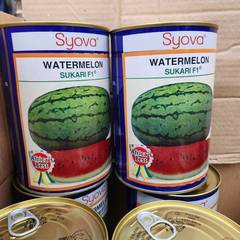
Sukari F1
Price range: KSh1,600.00 through KSh23,500.00 (-8%)
• Maturity: 80 –90 days
• Fruits are oblong in shape
• Avg fruit weight is 7 –8 kgs
• The rind is light green with
dark green stripes
• The flesh is deep red,
crispy & firm
• TSS 11 –12 %
• Thick rind: Good for long
distance transport
• Yield Potential: 25 tons/Ac
• Maturity: 80 –90 days
• Fruits are oblong in shape
• Avg fruit weight is 7 –8 kgs
• The rind is light green with
dark green stripes
• The flesh is deep red,
crispy & firm
• TSS 11 –12 %
• Thick rind: Good for long
distance transport
• Yield Potential: 25 tons/Acre
Gives best result when planted with yara Power fertilizer
Planting guide
Watermelon Planting Guide
1. Ideal Growing Conditions
| Factor | Requirement |
|---|---|
| Climate | Warm, sunny, and dry; optimal temperature 22–35°C |
| Rainfall | Moderate; avoid excessive rain during fruiting (causes rot) |
| Soil Type | Well-drained sandy loam or loam |
| Soil pH | Between 6.0 – 7.5 |
| Sunlight | Full sun exposure (6–8 hours daily) |
2. Land Preparation
-
Clear the field of weeds and debris.
-
Plough and harrow to a fine tilth for good root penetration.
-
Incorporate compost or well-rotted manure (8–10 tons/acre) to enrich the soil.
-
Form raised beds or ridges if soil is poorly drained.
3. Seed Selection
Use certified Sukari F1 hybrid seeds — a high-yielding, sweet variety with good shelf life and tolerance to common watermelon diseases.
4. Planting
| Item | Detail |
|---|---|
| Planting time | At onset of dry season under irrigation, or at start of short rains |
| Spacing | 1 m between plants × 1.5–2 m between rows |
| Seed rate | 0.5 kg per acre (approximately 4,000 seeds) |
| Depth | 2–3 cm deep |
| Method | Direct seeding or transplanting (2–3 week old seedlings) |
5. Fertilization and Foliar Application
| Stage | Recommendation |
|---|---|
| At Planting | Apply Yara Power or DAP, mixed with Mastahumix or Paranomix for strong root establishment. During the dry season, include Waterbank to retain soil moisture. Also apply a foliar high in Phosphorus (P) plus growth hormones to stimulate early root and shoot development. |
| Top Dressing (3–4 weeks) | Use CAN or Nitrabor plus Sulfur to promote healthy vegetative growth. Apply standard foliar or high Nitrogen foliar together with Rootmasta to enhance root and vine development. |
| Flowering and Fruiting | Apply potassium-rich fertilizers such as NPK 23:10:5 or MOP to improve fruit size and sweetness. Add Sulfan to enhance fruit color and flavor. Use High K foliar together with Azatone, Plantone, or Pluto to boost fruit filling and sugar content. |
| Important Tip | Always add a sticker/spreader (e.g. Integra or similar) when applying foliar sprays to improve absorption and effectiveness. |
6. Irrigation
-
Water regularly during germination and vegetative growth.
-
Reduce watering when fruits begin to mature to enhance sweetness.
-
Avoid waterlogging — drip irrigation is highly recommended.
7. Weed, Pest & Disease Management
Weeds
-
Control by hand hoeing or mulching to retain soil moisture.
Pests
-
Aphids, whiteflies, thrips, and leafminers → Use insecticides like Imidacloprid, Spinosad, or Abamectin.
-
Fruit flies → Use traps or Lambda-cyhalothrin sprays.
Diseases
-
Powdery mildew → Use Sulphur (⚠️ avoid during flowering as it causes flower abortion) or Difenoconazole.
-
Fungal diseases (Anthracnose, Fusarium wilt, or stem rot) → Use Thiophanate-methyl or Carbendazim.
-
Rotate crops and avoid continuous watermelon cropping to reduce soil-borne pathogens.
8. Pollination
-
Watermelon relies on bee pollination.
-
Maintain honeybee activity and avoid spraying insecticides during flowering (especially in the morning).
9. Harvesting
| Indicator | Description |
|---|---|
| Maturity period | 75–90 days (variety-dependent) |
| Signs of maturity | Tendril near fruit turns brown/dry, dull skin, yellow underside, hollow sound when tapped |
| Yield | 20–30 tons/acre (under good management) |
Harvest with a small stem attached and handle gently to avoid bruising.
10. Post-Harvest Handling
-
Store in a cool, shaded area with good ventilation.
-
Avoid stacking too high to prevent crushing.
-
For transport, cushion fruits with grass or paper.
Additional information
| Pack Size | 50gm, 100gm, 250gm, 500gm, 1kg |
|---|
