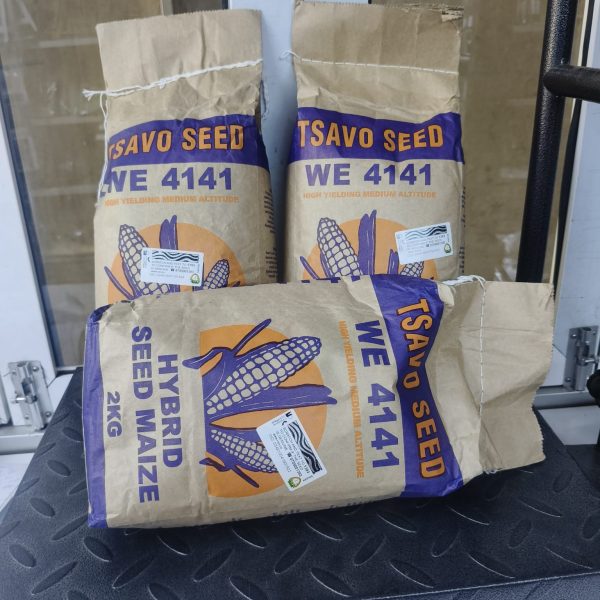
Tsavo WE 4141 Maize Seed Price in Kenya
The price of a 2kg pack may change depending on availability, season and supplier costs. Contact Dawn Farmers Ltd on 0748 949 184 to confirm the current price and stock before ordering.
Customers can collect their orders from Mang Building along Haile Selassie Avenue in Nairobi or request delivery to suitable destinations across Kenya.
Tsavo 4141 Maize Variety Specifications
| Variety | Tsavo WE 4141 |
|---|---|
| Seed type | Hybrid maize seed |
| Pack size | 2kg |
| Approximate maturity | About 90–110 days, depending on altitude, temperature and moisture |
| Approximate seed rate | 8–10kg per acre |
| Number of 2kg packs per acre | Approximately four to five packs |
| Suggested spacing | 75cm between rows and 25–30cm between planting stations |
| Target plant population | Approximately 21,000–24,000 established plants per acre |
| Potential yield | Approximately 35–45 bags per acre under favourable conditions and good management |
| Suitable conditions | Warm lowland and medium-altitude areas with sufficient seasonal rainfall |
| Primary uses | Dry grain, green maize and crop residue for livestock feed |
Maturity and yield figures are estimates rather than guarantees. Altitude, temperature, rainfall, soil fertility, planting time, plant population and crop management will affect field performance. Always follow the instructions printed on the current certified seed packet.
Key Features and Benefits
- Early maturity: Its relatively short production cycle may help farmers manage seasons with limited rainfall.
- Good yield potential: It can produce well-filled cobs when farmers provide adequate nutrition, moisture and crop protection.
- Adaptability: The variety can perform under different production conditions when matched with the correct growing zone.
- Good grain quality: It produces attractive grain suitable for household consumption and commercial markets.
- Useful crop residue: Properly harvested and stored maize stover may provide livestock feed after grain harvesting.
- Certified hybrid seed: Certified seed provides the genetic purity, uniformity and germination expected from the variety.
Suitable Growing Areas in Kenya
Tsavo 4141 maize may suit warm lowland and medium-altitude maize-growing areas with adequate seasonal rainfall. Farmers should ensure that the expected maturity period fits the length of the local rainy season.
The crop may be considered for suitable areas of Machakos, Makueni, Kitui, Kajiado, Embu, Meru, Tharaka-Nithi, Kirinyaga, Murang’a, Kiambu and other maize-growing counties. However, suitability can vary within the same county because of differences in altitude, rainfall, soil and temperature.
Farmers in cool high-altitude areas should expect the crop to develop more slowly than it does in warmer areas. Always obtain location-specific advice before buying seed for large-scale planting.
Rainfall and Moisture Requirements
The variety is associated with useful performance under variable rainfall, but it cannot produce a profitable crop without adequate moisture. Good soil moisture is especially important during:
- Germination and crop establishment
- Rapid vegetative development
- Tasselling and silking
- Pollination
- Cob development and grain filling
Plant at the beginning of reliable rains rather than after a brief isolated shower. Delayed planting can expose flowering and grain filling to moisture stress.
Land Preparation and Soil Requirements
Plant maize in deep, fertile and well-drained soil. Remove perennial weeds and prepare a reasonably fine seedbed before the rains begin. Avoid waterlogged fields because poor drainage restricts root development and can encourage root diseases.
A soil test provides the most reliable basis for selecting fertiliser and correcting soil acidity. Where laboratory results show that the soil is strongly acidic, apply agricultural lime according to professional recommendations.
How to Plant Tsavo WE 4141 Maize
- Plant at the beginning of reliable rainfall when the soil contains sufficient moisture.
- Use the spacing recommended on the current seed packet. A commonly used guide is 75cm between rows and 25–30cm between planting stations.
- Place the recommended basal fertiliser away from direct contact with the seed.
- Mix the fertiliser lightly with soil before placing the seed in the planting hole.
- Plant the seed approximately 3–5cm deep, depending on soil type and moisture.
- Cover the seed with loose soil without compacting the planting station excessively.
- Thin excessive seedlings early to achieve the required population.
- Replace missing plants promptly so that the replanted crop does not remain far behind the rest of the field.
How Much Seed Is Required per Acre?
Farmers generally require approximately 8–10kg per acre. Therefore, an acre may require about four to five 2kg packs.
The exact requirement depends on seed size, germination percentage, spacing and the target plant population. Avoid planting excessive numbers of seeds because overcrowding increases competition for water, nutrients and sunlight.
Fertiliser Programme
Use soil-test results and local agronomic recommendations to develop a fertiliser programme. Depending on the soil analysis, farmers may apply a suitable planting fertiliser followed by a nitrogen top-dressing fertiliser such as CAN or urea.
Basal fertiliser
Apply the recommended planting fertiliser during sowing. Do not place untreated fertiliser in direct contact with the seed because concentrated salts may damage emerging roots or reduce germination.
Top-dressing
Apply nitrogen when the crop is actively growing and the soil has sufficient moisture. Split applications may improve nutrient-use efficiency in sandy soils or areas receiving heavy rainfall.
Avoid applying nitrogen fertiliser to a severely moisture-stressed crop. Keep top-dressing fertiliser away from direct contact with the maize stem.
Browse suitable products in the Dawn Farmers fertiliser category.
Weed Management
Keep the field free from weeds during the early stages of crop growth. Weeds compete with maize for nutrients, moisture, space and sunlight.
Begin weed management before weeds become large. If using a herbicide, select a product registered for maize and follow its label concerning crop stage, weed spectrum, application rate, water volume and safety precautions.
Avoid allowing herbicide spray to drift onto neighbouring crops. Seek agronomic advice where crop injury, herbicide resistance or difficult perennial weeds are suspected.
Pest Management
Inspect the crop regularly from emergence onwards. Important maize pests may include:
- Fall armyworm
- Cutworms
- Stalk borers
- Aphids
- Termites
- Storage weevils
Correctly identify the pest and assess the level of infestation before applying an insecticide. Use only products registered for maize in Kenya and follow their labels.
When managing fall armyworm, direct the spray into the maize whorl while the larvae are still young. Rotate insecticides with different modes of action to delay resistance.
Disease Management
Resistance and tolerance claims can vary between suppliers and seed batches. Confirm the disease profile printed on the current seed packet rather than relying on an unsupported general claim.
Farmers should scout for common maize diseases, including:
- Maize streak disease
- Grey leaf spot
- Maize rust
- Northern leaf blight
- Cob and ear rots
- Maize lethal necrosis disease
Use certified seed, rotate maize with suitable non-cereal crops, control volunteer maize and manage crop residues appropriately. Obtain a proper diagnosis before applying a fungicide because chemical treatment cannot cure viral diseases.
Farmers can consult the Kenya Plant Health Inspectorate Service for information about certified seed and recognised varieties.
Harvesting Tsavo 4141 Maize
Harvest dry-grain maize after the crop reaches physiological maturity and the cobs dry adequately. Delayed harvesting may expose the crop to birds, rodents, lodging, ear rots and unpredictable rainfall.
For green-maize markets, harvest at the preferred eating stage and arrange buyers in advance because fresh cobs have a short marketing period.
Drying and Storage
Dry grain to a safe storage moisture level before shelling or long-term storage. Remove damaged, rotten, discoloured and visibly mouldy cobs.
Store clean, dry grain in suitable pest-resistant containers or hermetic bags. Keep stored maize away from moisture, direct contact with the floor and sources of contamination.
Never consume or feed visibly mouldy maize to livestock. Poor drying and storage can encourage fungal growth and aflatoxin contamination.
Expected Yield per Acre
Some commercial descriptions associate the variety with approximately 35–45 bags per acre under favourable growing conditions. This figure represents potential performance and is not a guaranteed harvest.
Actual yield will depend on rainfall, soil fertility, plant population, weed management, pest and disease control, harvesting losses and the weight used to define one bag.
Frequently Asked Questions
What is Tsavo WE 4141?
It is an early-maturing hybrid maize variety supplied for grain and green-maize production. It is available in a 2kg seed pack.
How long does Tsavo 4141 take to mature?
The crop commonly takes approximately 90–110 days to mature. Warm conditions may accelerate development, while cooler highland conditions can extend the maturity period.
How much Tsavo WE 4141 maize seed is required for one acre?
Approximately 8–10kg may be required per acre. This equals about four to five 2kg packs, depending on seed size, germination, spacing and target population.
How many acres can one 2kg packet plant?
One 2kg packet may plant approximately one-fifth to one-quarter of an acre. The exact area depends on spacing, germination and the number of seeds placed at each station.
How many bags can Tsavo 4141 produce per acre?
The variety is commonly associated with a potential yield of approximately 35–45 bags per acre under favourable conditions and good crop management. This is not a guaranteed yield.
Can Tsavo 4141 grow in dry areas?
It may perform under variable rainfall, but drought tolerance does not mean that the crop can grow without water. Adequate moisture remains critical during germination, flowering, pollination and grain filling.
Is Tsavo 4141 suitable for high-altitude areas?
Cooler high-altitude conditions may extend its maturity period. Farmers should confirm local suitability and compare it with varieties specifically recommended for their altitude before planting it on a large scale.
Can farmers replant harvested grain?
Replanting harvested hybrid grain is not recommended. The next generation may lose uniformity, vigour and yield performance. Plant fresh certified hybrid seed every season.
Where can I buy Tsavo WE 4141 maize seed in Nairobi?
Buy the 2kg pack from Dawn Farmers Ltd at Mang Building along Haile Selassie Avenue, Nairobi. Call or WhatsApp 0748 949 184 to confirm availability before travelling.
Does Dawn Farmers deliver outside Nairobi?
Yes. Dawn Farmers serves customers in Nairobi and arranges delivery to suitable destinations across Kenya. The delivery cost and estimated arrival time depend on the destination and order size.
Order Tsavo WE 4141 Maize Seed in Kenya
Order certified 2kg packs from Dawn Farmers Ltd. We serve farmers, agrovets, institutions and agricultural organisations in Nairobi and across Kenya.
- Business: Dawn Farmers Ltd
- Location: Mang Building, Haile Selassie Avenue, Nairobi
- Call or WhatsApp: 0748 949 184
- Website: www.dawnfarmers.com
Contact Dawn Farmers to confirm the current price, stock, batch details and delivery charges before ordering.