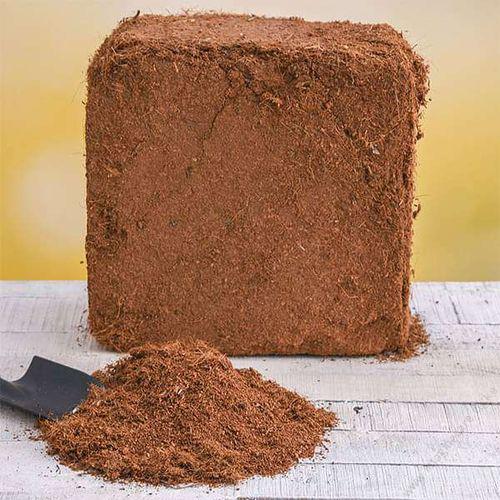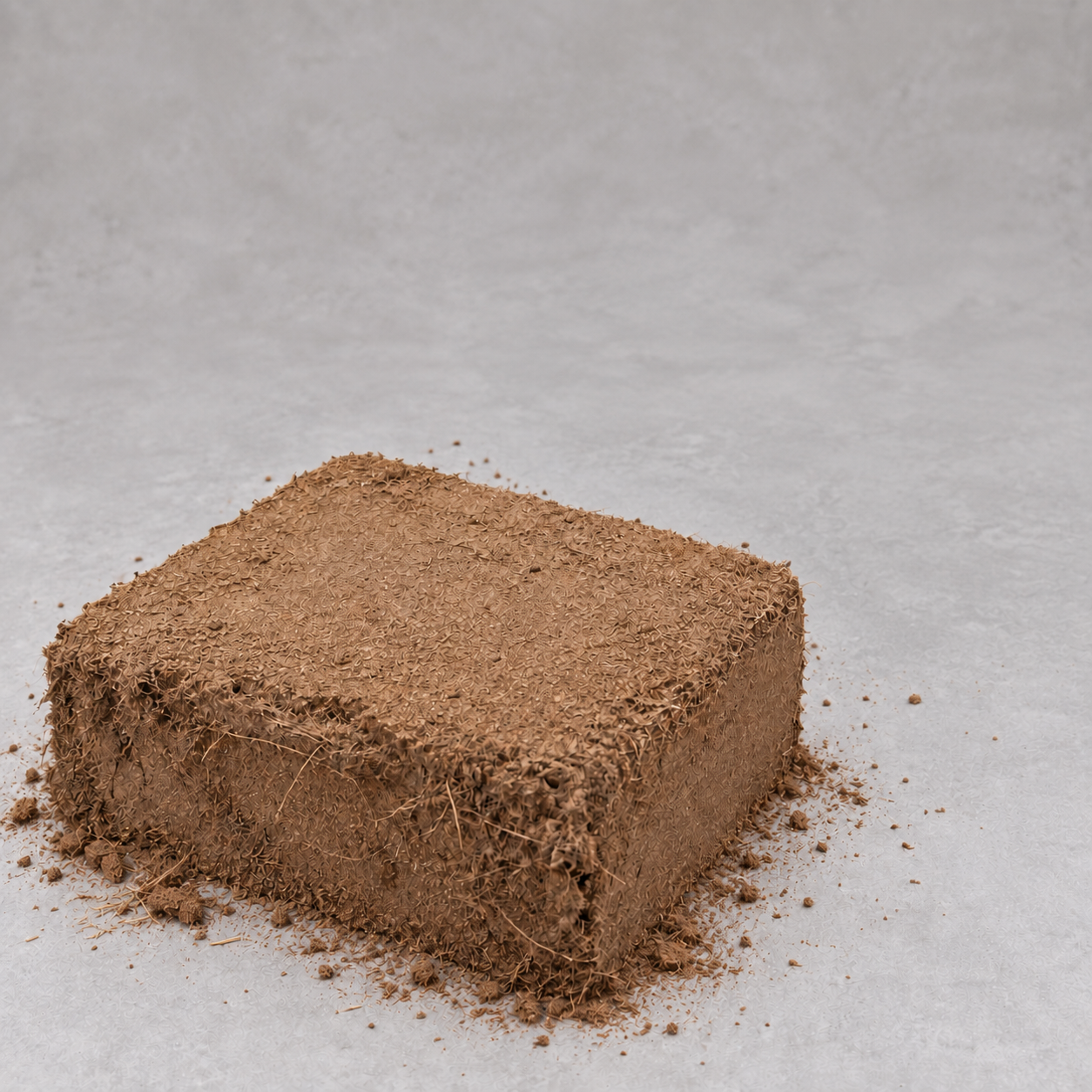
In addition, farmers, nursery operators, landscapers and home growers can buy treated cocopeat blocks from Dawn Farmers Ltd in Nairobi. Customers outside Nairobi can enquire about current stock, prices and delivery arrangements across Kenya.
What Is Treated Cocopeat?
Cocopeat, also called coir pith, is the fine, spongy material that producers obtain from coconut husks. They wash, screen, dry and press it into blocks for easier storage and transport. Depending on the product, they may also wash it to reduce salts and buffer it to improve its mineral balance.
However, the word treated does not give every technical detail. Before use, check the packaging or supplier information for washing, buffering, salt level (EC) and pH. Product quality can differ according to the raw material and processing method.
Key Benefits of a 5 kg Cocopeat Block
- Moisture management: Fine coir particles can retain useful moisture around the root zone.
- Root-zone aeration: A suitable particle structure maintains pore space for oxygen and root respiration.
- Convenient transport: Pressing reduces the space required before you add water.
- Easy rewetting: Cocopeat generally rewets more readily than some dry organic media.
- Versatile mixing: Growers can use it alone in an appropriate managed system or combine it with other materials.
- Renewable raw material: Coir uses material derived from coconut husks.
Nevertheless, these benefits depend on particle size, salt level, treatment quality, irrigation and the other materials in the growing mix. Therefore, growers may need to adjust cocopeat for a specific crop or system.
Common Uses of Treated Cocopeat in Kenya
Seedling nurseries
First, fine, clean cocopeat can support seed sprouting and early root growth when growers manage moisture correctly. Growers may use it in seedling trays or combine it with another suitable material to adjust drainage, air spaces and water retention.
Potting and container mixes
Also, cocopeat can form part of a potting mix for vegetables, herbs, flowers, ornamental plants and tree seedlings. The correct blend depends on crop duration, container depth, watering frequency and the drainage of the other materials.
Greenhouse and soilless production
Moreover, growers can use cocopeat in well-designed greenhouse or soilless systems. Because the medium does not provide complete crop nutrition, growers must supply balanced nutrients and monitor watering, drainage, pH and salt level (EC).
Improving selected soil mixes
Finally, mixing a suitable amount of cocopeat into selected soil blends may improve moisture spread and structure. However, cocopeat cannot correct a poorly drained field on its own. Field drainage, soil texture and crop needs still matter.
How to Prepare a Treated Cocopeat Block
- Place the block in a clean container, trough or on a clean waterproof surface.
- Add clean water gradually according to the manufacturer’s instructions.
- Allow the block time to absorb water and expand.
- Break apart the softened material using clean hands or tools.
- Fluff the cocopeat until its texture becomes reasonably uniform.
- Check for excess water and allow it to drain before filling trays or containers.
- If the crop is sensitive or the production system is intensive, test or confirm the pH and EC before planting.
Do not assume that every 5 kg block produces the same volume after adding water. Final volume depends on how firmly the producer pressed the block, its moisture and particle grade. Therefore, confirm the volume shown by the manufacturer before calculating how many blocks your nursery needs.
Does Treated Cocopeat Need Calcium Nitrate?
Not necessarily. If the producer has already buffered the cocopeat correctly, repeating the process without test results can waste inputs and change the nutrient balance. First, confirm whether the producer only washed the block or both washed and buffered it.
Untreated or poorly buffered coir may contain high levels of soluble salts, sodium or potassium. For commercial growing, a growing-media test or reliable EC and pH readings can guide the decision. Therefore, follow the supplier’s instructions or seek professional advice instead of using one calcium-nitrate recipe for every product.
Is Cocopeat a Fertiliser?
No. Cocopeat is mainly a growing medium, not a complete fertiliser. It creates a useful root environment, but the crop still needs balanced nutrients. Thus, match the feeding programme to the crop, water quality, growth stage and growing system.
For nurseries and soilless growing, monitor crop response and the nutrient solution instead of judging the medium by appearance. For example, excess fertiliser can raise EC and damage young roots, while too little fertiliser can produce weak plants.
Should Cocopeat Be Used Alone or Mixed?
Either approach may suit a well-managed system. A grower using cocopeat alone needs close control of feeding, watering and drainage. In contrast, nursery and container growers may mix cocopeat with carefully chosen materials to balance moisture and air around the roots.
For example, companion media include vermiculite and suitable grades of peat moss. Do not use one fixed mixing ratio for every crop. Small nursery cells, large pots and long-term containers need different amounts of water and air.
How to Choose a Quality Cocopeat Block
| Factor | What to confirm | Why it matters |
|---|---|---|
| Treatment | Whether the product is washed, buffered or both | Shows whether the block may need more preparation |
| Electrical conductivity | The supplier’s stated EC and test method | High soluble-salt levels can injure sensitive roots |
| pH | Declared pH range | pH influences nutrient availability |
| Particle grade | Fine pith, fibre, chips or a specified blend | Particle size affects drainage and water holding |
| Expanded volume | Expected volume after hydration | Helps you calculate nursery needs and costs |
| Cleanliness | Freedom from debris, weeds and visible contamination | Supports more consistent nursery hygiene |
Common Cocopeat Mistakes to Avoid
- Planting before the compressed block has hydrated evenly.
- Keeping trays continuously saturated and depriving roots of oxygen.
- Assuming cocopeat supplies a complete nutrient programme.
- Ignoring water quality, pH, EC and drainage in intensive production.
- Applying calcium nitrate again without confirming whether the product is already buffered.
- Using contaminated tools, containers or storage surfaces.
- Buying by block weight without checking particle grade and expanded volume.
Frequently Asked Questions
What is a treated cocopeat block?
It is pressed coir pith that a producer has washed and, depending on the product details, buffered. Therefore, confirm the exact treatment on the label or supplier information.
How much does a cocopeat block expand?
Expansion varies by product, how firmly the producer pressed it, particle grade and initial moisture. Therefore, use the volume shown by the manufacturer for nursery calculations instead of relying on a general estimate.
Can I plant directly into treated cocopeat?
Yes, when its pH, EC, structure and treatment suit the crop and growing system. However, you must still provide suitable nutrients and water.
Is treated cocopeat suitable for seedlings?
Yes. Growers can use suitable fine-grade cocopeat for seedlings when they keep it clean, add water correctly and maintain both moisture and air around the roots.
Where can I buy a treated cocopeat block 5kg in Nairobi?
Buy a treated 5 kg cocopeat block from Dawn Farmers Ltd at Mang Building, Haile Selassie Avenue, Nairobi. Call 0724 367 713 or WhatsApp 0713 064 228 to confirm current stock, price and delivery options across Kenya.
Related Products from Dawn Farmers Ltd
- Treated Cocopeat Blocks 5 kg
- Vermiculite 20 kg
- Rekyva Peatmoss 250 litres
- Oboya Peatmoss Substrate 250 litres
Buy Treated Cocopeat in Nairobi with Delivery Enquiries Across Kenya
In conclusion, a treated cocopeat block offers a practical way to transport and prepare growing media for nurseries, containers and managed greenhouse systems. For the best results, check treatment quality, add water correctly, manage drainage and supply balanced crop nutrients.
Order your treated cocopeat block 5kg in Kenya from Dawn Farmers Ltd. Visit us at Mang Building, Haile Selassie Avenue, Nairobi, call 0724 367 713, or WhatsApp 0713 064 228. Confirm the current price, stock and delivery arrangement before ordering.