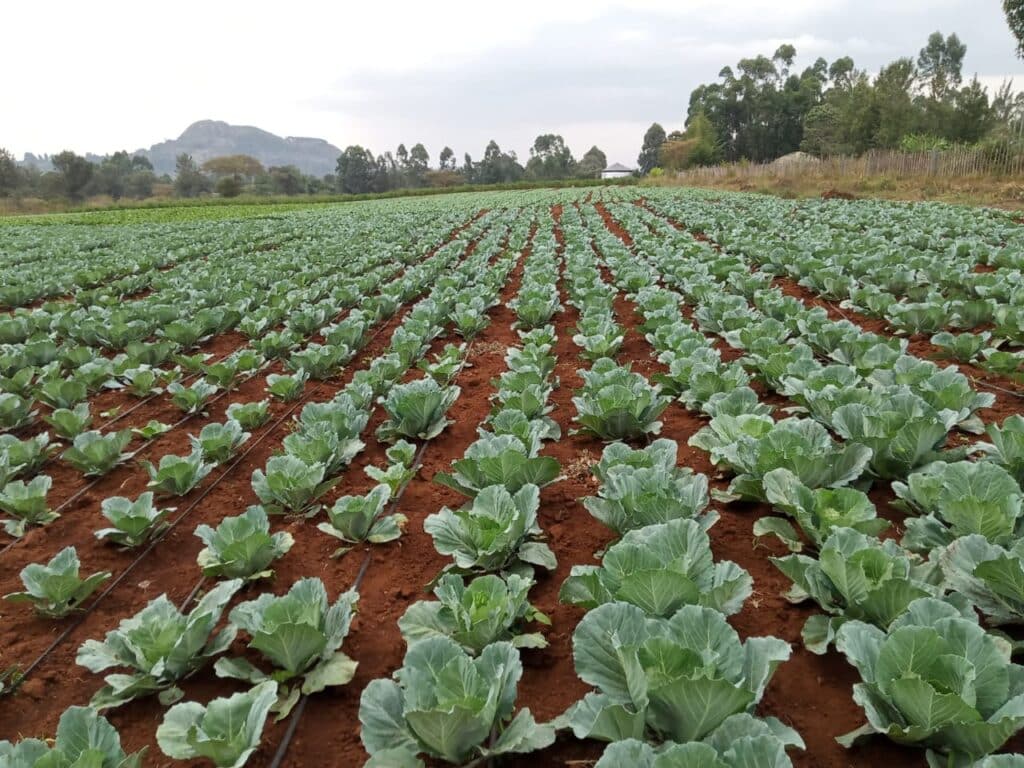
Cabbage farming in Kenya succeeds when variety choice, nursery management, spacing, nutrition, irrigation and crop protection are planned together. Farmers should begin with the intended market and production season, then select seed and field management practices that fit those conditions.
Choose Cabbage Seed for the Farm and Market
When comparing cabbage seeds in Kenya, look at maturity, head type, documented field traits and market preference. Dawn Farmers lists Oxylus F1, Tropicana F1 and other hybrid cabbage seeds in the seed catalogue.
| Crop Stage | Main Management Question | Why It Matters |
|---|---|---|
| Nursery | Are seedlings healthy and uniform? | Strong seedlings establish more evenly |
| Transplanting | Does spacing fit variety and head size? | Influences plant population and airflow |
| Vegetative growth | Are nutrition and moisture balanced? | Supports canopy and head development |
| Head formation | Are pests, disease and water stress controlled? | Protects marketable quality |
Nursery and Transplanting
Good cabbage nursery management uses clean media, careful watering and healthy seedlings. Cabbage spacing should follow variety and local agronomic guidance because spacing affects airflow, final plant population and expected head size.
Nutrition Irrigation and Head Formation
Cabbage fertilizer decisions should consider soil fertility and crop stage rather than using one programme on every field. Cabbage irrigation should maintain steady growth while avoiding prolonged waterlogging. Severe moisture stress during cabbage head formation can reduce crop performance.
Pest and Disease Scouting
Cabbage pest management starts with identifying the actual pest before treatment. Caterpillars, aphids and thrips can require different responses. Cabbage disease management also depends on correct diagnosis, field hygiene, irrigation practices and suitable crop-protection decisions.
Compare Varieties and Buying Options
Cabbage varieties in Kenya should be compared by farm fit and market need before price. Farmers looking for cabbage seeds for sale in Kenya can browse the Dawn Farmers Seeds category and confirm the exact variety and pack size before ordering.
Practical point: strong heads begin with healthy seedlings and a uniform stand. Keep records of transplanting date, fertilizer, irrigation and crop-protection events.
About the product and variety information used here: Dawn Farmers lists hybrid cabbage options including Oxylus F1 and Tropicana F1. Variety choice should be matched to local conditions and market needs, while exact maturity and spacing should be checked on current seed information.
Choose a Cabbage Market Before Choosing a Variety
Cabbage varieties differ in head size, shape, maturity and adaptation, and markets can prefer different types. The best seed is therefore the one that fits both the production environment and the intended buyer.
Farmers supplying local fresh markets may have different requirements from growers serving institutions or wholesale channels. Plan market outlet, transport distance and preferred head characteristics before planting.
For cabbage farming, the decision around choose a Cabbage Market Before Choosing a Variety is strongest when the farmer can explain exactly what is being purchased and why. That means comparing specification or label information, the quantity required, storage or handling needs, and the cost of getting the input to the farm. A lower shelf price can be poor value when the wrong product is bought, while a higher-priced option is not automatically better simply because it carries a recognised brand. Keep the production objective in front of the buying decision and ask for the exact item, formulation, variety or specification rather than accepting a vague substitute.
When applying the lesson from choose a Cabbage Market Before Choosing a Variety to cabbage farming, separate what can be controlled from what cannot. Weather will change, but the farm can still control preparation, timing, input identity, equipment condition and record keeping. When conditions move away from the original plan, adjust the operation through agronomic reasoning instead of adding more product automatically. This approach keeps the decision resilient because it remains linked to the actual field rather than to a rigid recipe.
Before committing money or labour to choose a Cabbage Market Before Choosing a Variety, ask what information would make the decision less uncertain for cabbage farming. It may be a soil test, a seed label, a pest count, a calibration measurement, a weather forecast, a market order or a current price. Collecting that information before spending money usually costs less than correcting the consequences of a poorly matched input. This habit is one of the clearest differences between reactive farming and deliberate farm management.
The idea behind cabbage farming in Kenya becomes most useful when it is applied to a real field decision. For cabbage farming, compare the farm conditions, stage of production and evidence from scouting or records before changing the programme.
Compare Hybrid Cabbage Varieties Carefully
Dawn Farmers lists hybrid options including Oxylus F1 and Tropicana F1. Exact maturity, disease traits and spacing should be confirmed from current variety information.
Do not assume that one hybrid is universally superior because performance changes with altitude, season, soil and management. A small trial can help farmers compare a new variety against one already known on the farm.
How to Apply Compare Hybrid Cabbage Varieties Carefully on the Farm
The farm-level value of compare Hybrid Cabbage Varieties Carefully comes from consistency in cabbage farming. One well-managed operation supports the next: uniform establishment improves scouting, good scouting improves timing, and accurate timing makes every later input easier to justify. Small variations in depth, plant population, operator technique or field condition can become large yield differences when they are repeated over a whole field. Use a simple checklist before the operation begins, observe the result afterwards, and record anything unusual so the next season is based on evidence rather than memory.
For a commercial grower managing cabbage farming, compare Hybrid Cabbage Varieties Carefully is also a cost-control point. Every pass through the field uses labour, fuel or carrying effort and may expose the crop to additional risk. An operation should therefore have a clear objective and a way to judge whether it worked. Record the date, field or block, input or equipment used and any observation that explains the result. Over time, those records show which practices are worth repeating.
Raise Uniform Seedlings
A uniform nursery produces transplants that establish and mature more evenly. Use clean propagation media, appropriate seed depth, good drainage and enough light.
Crowded seedlings compete for light and are more vulnerable to disease. Keep nursery records so seed lot and sowing date can be linked to field performance.
The farm-level value of raise Uniform Seedlings comes from consistency in cabbage farming. One well-managed operation supports the next: uniform establishment improves scouting, good scouting improves timing, and accurate timing makes every later input easier to justify. Small variations in depth, plant population, operator technique or field condition can become large yield differences when they are repeated over a whole field. Use a simple checklist before the operation begins, observe the result afterwards, and record anything unusual so the next season is based on evidence rather than memory.
A common mistake around raise Uniform Seedlings is to respond to one disappointing symptom by changing several things at once. That makes it difficult to know which change helped and can create hidden interactions. Where possible, correct the most likely limiting factor first, observe cabbage farming, and keep other management stable. This is especially important when fertilizers or pesticides are involved, because unnecessary combinations increase cost and may create crop-safety or compatibility problems.
Before committing money or labour to raise Uniform Seedlings, ask what information would make the decision less uncertain for cabbage farming. It may be a soil test, a seed label, a pest count, a calibration measurement, a weather forecast, a market order or a current price. Collecting that information before spending money usually costs less than correcting the consequences of a poorly matched input. This habit is one of the clearest differences between reactive farming and deliberate farm management.
Farmers researching cabbage seeds in Kenya should connect the phrase to practical management: what the crop needs, what the field can supply, what the current label or variety information says and what outcome will be measured afterwards.
Prevent Damping-Off in the Nursery
Damping-off is favoured by overly wet media, poor airflow and contaminated nursery conditions. Avoid keeping seedling media continuously saturated.
Use clean trays or beds and remove collapsed seedlings quickly. Fungicide treatment should be based on correct diagnosis and labelled nursery use rather than used as a substitute for sanitation.
The farm-level value of prevent Damping-Off in the Nursery comes from consistency in cabbage farming. One well-managed operation supports the next: uniform establishment improves scouting, good scouting improves timing, and accurate timing makes every later input easier to justify. Small variations in depth, plant population, operator technique or field condition can become large yield differences when they are repeated over a whole field. Use a simple checklist before the operation begins, observe the result afterwards, and record anything unusual so the next season is based on evidence rather than memory.
The scale of prevent Damping-Off in the Nursery matters in cabbage farming. A decision that seems minor on a few plants can become expensive over several acres. Before applying it across the whole farm, confirm that the method, product or variety fits the field and that workers understand the procedure. Small trial areas, calibration checks and written instructions can prevent a repeated error from affecting an entire crop.
In practice, hybrid cabbage seeds should not be treated as a stand-alone promise. Its value depends on how well the product, variety or method fits cabbage farming under the actual conditions on the farm.
Harden Seedlings Before Transplanting
Gradual exposure to field conditions reduces transplant shock. Seedlings moved directly from heavy shade and constant watering into a hot field can wilt severely.
Harden plants without allowing damaging stress. Transplant strong seedlings with healthy roots and avoid carrying weak or diseased plants into the field.
How to Apply Harden Seedlings Before Transplanting on the Farm
The farm-level value of harden Seedlings Before Transplanting comes from consistency in cabbage farming. One well-managed operation supports the next: uniform establishment improves scouting, good scouting improves timing, and accurate timing makes every later input easier to justify. Small variations in depth, plant population, operator technique or field condition can become large yield differences when they are repeated over a whole field. Use a simple checklist before the operation begins, observe the result afterwards, and record anything unusual so the next season is based on evidence rather than memory.
Good decisions about harden Seedlings Before Transplanting also leave room for local knowledge. Soil type, altitude, water quality, pest pressure and market conditions vary across Kenya, so general guidance should be refined with current local recommendations and product information. Use this principle with cabbage farming: understand the agronomy first, then adapt the details to the farm rather than copying a programme from a different production environment.
Before committing money or labour to harden Seedlings Before Transplanting, ask what information would make the decision less uncertain for cabbage farming. It may be a soil test, a seed label, a pest count, a calibration measurement, a weather forecast, a market order or a current price. Collecting that information before spending money usually costs less than correcting the consequences of a poorly matched input. This habit is one of the clearest differences between reactive farming and deliberate farm management.
Prepare Soil for Head Development
Cabbage needs a root zone with adequate moisture, good drainage and balanced fertility. Compaction restricts roots, while waterlogging increases disease risk.
Soil pH influences nutrient availability and some soil-borne disease risks. Use soil tests and field history to plan liming or fertilizer rather than waiting for symptoms after head formation begins.
The practical lesson from prepare Soil for Head Development is to connect nutrient decisions with evidence from the field. In cabbage, roots can only use nutrients that are available in the root zone and accessible under the prevailing moisture and pH conditions. A crop that is waterlogged, drought stressed or suffering from damaged roots may show poor growth even when fertilizer has been applied. Before adding another product, review what has already been used, where it was placed, recent rainfall or irrigation, and whether the symptom pattern is consistent across the field. This discipline keeps cabbage farming from becoming a sequence of expensive fertilizer guesses.
Connect prepare Soil for Head Development to the next decision in the cabbage farming season. If establishment is uneven, later fertilizer and spray calculations may need to account for a lower plant population. If a pest treatment is delayed, scouting frequency may need to increase. If water is limiting, nutrient uptake may change. Thinking in sequences turns this step into part of a complete crop-management system instead of an isolated task.
Effective cabbage nursery management is rarely a single-product decision. It combines prevention, field observation, timing, accurate application and follow-up so that cabbage farming is managed as a system rather than through isolated reactions.
Spacing and Plant Population
Spacing affects head size, plant population, airflow and marketable yield. The correct arrangement depends on variety, target head size, soil fertility and growing conditions.
Very tight spacing can increase humidity and produce smaller heads, while excessively wide spacing reduces the number of plants per area. Follow current variety and local recommendations.
The farm-level value of spacing and Plant Population comes from consistency in cabbage farming. One well-managed operation supports the next: uniform establishment improves scouting, good scouting improves timing, and accurate timing makes every later input easier to justify. Small variations in depth, plant population, operator technique or field condition can become large yield differences when they are repeated over a whole field. Use a simple checklist before the operation begins, observe the result afterwards, and record anything unusual so the next season is based on evidence rather than memory.
After completing the work around spacing and Plant Population, set one or two observations to check in cabbage farming. These might include emergence uniformity, crop colour, weed escape, pest numbers, nozzle output, fruit quality or marketable harvest depending on the stage. Without a follow-up observation, it is easy to repeat a costly practice simply because it has always been done that way.
Before committing money or labour to spacing and Plant Population, ask what information would make the decision less uncertain for cabbage farming. It may be a soil test, a seed label, a pest count, a calibration measurement, a weather forecast, a market order or a current price. Collecting that information before spending money usually costs less than correcting the consequences of a poorly matched input. This habit is one of the clearest differences between reactive farming and deliberate farm management.
Transplant Establishment
Transplant into moist soil and water promptly where rainfall is not dependable. Keep the growing point above soil and avoid burying stems excessively.
Replace missing plants early so the stand remains reasonably uniform. A strong first few weeks reduce later differences in head maturity.
How to Apply Transplant Establishment on the Farm
The farm-level value of transplant Establishment comes from consistency in cabbage farming. One well-managed operation supports the next: uniform establishment improves scouting, good scouting improves timing, and accurate timing makes every later input easier to justify. Small variations in depth, plant population, operator technique or field condition can become large yield differences when they are repeated over a whole field. Use a simple checklist before the operation begins, observe the result afterwards, and record anything unusual so the next season is based on evidence rather than memory.
If advice about transplant Establishment from a supplier, neighbour and agronomist differs, compare each recommendation against current label or variety information and the conditions in the field. The most persuasive recommendation for cabbage farming is the one that explains why it fits the crop, stage and problem. That standard reduces dependence on brand reputation or hearsay.
The idea behind cabbage spacing becomes most useful when it is applied to a real field decision. For cabbage farming, compare the farm conditions, stage of production and evidence from scouting or records before changing the programme.
Irrigation and Moisture Consistency
Cabbage needs reliable moisture for leaf expansion and head development. Repeated drought stress followed by heavy watering can contribute to uneven growth and head-quality problems.
Irrigation should respond to soil type, weather and crop stage. Good drainage remains important because cabbage roots also suffer in saturated soil.
For cabbage farming, irrigation and Moisture Consistency should be treated as a root-zone decision rather than a fixed calendar. Soil texture, rooting depth, crop size, weather and drainage all change how quickly water becomes limiting. Both shortage and excess can reduce nutrient uptake and make pest or disease symptoms harder to interpret. Check the soil as well as the leaves, and adjust irrigation or moisture-conservation practices before assuming every stress symptom requires another chemical or fertilizer input. Where irrigation is used, uniform delivery across the field is as important as total water applied.
When applying the lesson from irrigation and Moisture Consistency to cabbage farming, separate what can be controlled from what cannot. Weather will change, but the farm can still control preparation, timing, input identity, equipment condition and record keeping. When conditions move away from the original plan, adjust the operation through agronomic reasoning instead of adding more product automatically. This approach keeps the decision resilient because it remains linked to the actual field rather than to a rigid recipe.
Before committing money or labour to irrigation and Moisture Consistency, ask what information would make the decision less uncertain for cabbage farming. It may be a soil test, a seed label, a pest count, a calibration measurement, a weather forecast, a market order or a current price. Collecting that information before spending money usually costs less than correcting the consequences of a poorly matched input. This habit is one of the clearest differences between reactive farming and deliberate farm management.
Nutrition From Vegetative Growth to Heading
Cabbage first builds a large leaf canopy and later directs growth into the head. Nitrogen supports vegetative growth, while potassium, calcium, sulfur and other nutrients contribute to plant function and quality.
An unbalanced programme can create excessive soft growth or nutrient disorders. Soil tests and crop observation should guide fertilizer timing.
The practical lesson from nutrition From Vegetative Growth to Heading is to connect nutrient decisions with evidence from the field. In cabbage, roots can only use nutrients that are available in the root zone and accessible under the prevailing moisture and pH conditions. A crop that is waterlogged, drought stressed or suffering from damaged roots may show poor growth even when fertilizer has been applied. Before adding another product, review what has already been used, where it was placed, recent rainfall or irrigation, and whether the symptom pattern is consistent across the field. This discipline keeps cabbage farming from becoming a sequence of expensive fertilizer guesses.
For a commercial grower managing cabbage farming, nutrition From Vegetative Growth to Heading is also a cost-control point. Every pass through the field uses labour, fuel or carrying effort and may expose the crop to additional risk. An operation should therefore have a clear objective and a way to judge whether it worked. Record the date, field or block, input or equipment used and any observation that explains the result. Over time, those records show which practices are worth repeating.
Farmers researching cabbage fertilizer should connect the phrase to practical management: what the crop needs, what the field can supply, what the current label or variety information says and what outcome will be measured afterwards.
Calcium and Physiological Disorders
Calcium moves with water through the plant and is important for cell structure. Deficiency symptoms can occur even when soil calcium is present if root uptake or water movement is poor.
Moisture management, root health and nutrient balance therefore matter alongside calcium fertilizer. Do not diagnose a nutrient disorder from one symptom without considering disease and environmental causes.
How to Apply Calcium and Physiological Disorders on the Farm
For cabbage farming, the decision around calcium and Physiological Disorders is strongest when the farmer can explain exactly what is being purchased and why. That means comparing specification or label information, the quantity required, storage or handling needs, and the cost of getting the input to the farm. A lower shelf price can be poor value when the wrong product is bought, while a higher-priced option is not automatically better simply because it carries a recognised brand. Keep the production objective in front of the buying decision and ask for the exact item, formulation, variety or specification rather than accepting a vague substitute.
A common mistake around calcium and Physiological Disorders is to respond to one disappointing symptom by changing several things at once. That makes it difficult to know which change helped and can create hidden interactions. Where possible, correct the most likely limiting factor first, observe cabbage farming, and keep other management stable. This is especially important when fertilizers or pesticides are involved, because unnecessary combinations increase cost and may create crop-safety or compatibility problems.
Before committing money or labour to calcium and Physiological Disorders, ask what information would make the decision less uncertain for cabbage farming. It may be a soil test, a seed label, a pest count, a calibration measurement, a weather forecast, a market order or a current price. Collecting that information before spending money usually costs less than correcting the consequences of a poorly matched input. This habit is one of the clearest differences between reactive farming and deliberate farm management.
Effective cabbage pest management is rarely a single-product decision. It combines prevention, field observation, timing, accurate application and follow-up so that cabbage farming is managed as a system rather than through isolated reactions.
Weed Control Before Canopy Closure
Young cabbage competes poorly with established weeds. Control weeds early through cultivation, mulching, hand weeding or labelled herbicides where suitable.
Once the crop canopy closes, shading can reduce later weed growth. Avoid damaging shallow roots during mechanical weeding.
The practical lesson from weed Control Before Canopy Closure is to connect nutrient decisions with evidence from the field. In cabbage, roots can only use nutrients that are available in the root zone and accessible under the prevailing moisture and pH conditions. A crop that is waterlogged, drought stressed or suffering from damaged roots may show poor growth even when fertilizer has been applied. Before adding another product, review what has already been used, where it was placed, recent rainfall or irrigation, and whether the symptom pattern is consistent across the field. This discipline keeps cabbage farming from becoming a sequence of expensive fertilizer guesses.
The scale of weed Control Before Canopy Closure matters in cabbage farming. A decision that seems minor on a few plants can become expensive over several acres. Before applying it across the whole farm, confirm that the method, product or variety fits the field and that workers understand the procedure. Small trial areas, calibration checks and written instructions can prevent a repeated error from affecting an entire crop.
Manage Caterpillars and Leaf Damage
Caterpillars can damage leaves and contaminate heads, so scouting should begin early. Inspect the underside of leaves and the developing centre of plants.
Natural enemies can contribute to control, and repeated use of one insecticide mode of action can select for resistance. When treatment is justified, choose a product labelled for cabbage and the target pest.
The farm-level value of manage Caterpillars and Leaf Damage comes from consistency in cabbage farming. One well-managed operation supports the next: uniform establishment improves scouting, good scouting improves timing, and accurate timing makes every later input easier to justify. Small variations in depth, plant population, operator technique or field condition can become large yield differences when they are repeated over a whole field. Use a simple checklist before the operation begins, observe the result afterwards, and record anything unusual so the next season is based on evidence rather than memory.
Good decisions about manage Caterpillars and Leaf Damage also leave room for local knowledge. Soil type, altitude, water quality, pest pressure and market conditions vary across Kenya, so general guidance should be refined with current local recommendations and product information. Use this principle with cabbage farming: understand the agronomy first, then adapt the details to the farm rather than copying a programme from a different production environment.
Before committing money or labour to manage Caterpillars and Leaf Damage, ask what information would make the decision less uncertain for cabbage farming. It may be a soil test, a seed label, a pest count, a calibration measurement, a weather forecast, a market order or a current price. Collecting that information before spending money usually costs less than correcting the consequences of a poorly matched input. This habit is one of the clearest differences between reactive farming and deliberate farm management.
A useful way to evaluate cabbage irrigation is to ask what changes in the field if this decision is correct. The answer should be observable through establishment, crop health, application quality, harvest or cost records rather than through marketing language alone.
Aphids Thrips and Sap-Sucking Pests
Sap-sucking pests can distort growth, contaminate produce and sometimes transmit disease. Dense colonies may hide inside developing heads where spray coverage becomes difficult.
Early detection is therefore important. Use selective, labelled products and consider beneficial insects in the management decision.
How to Apply Aphids Thrips and Sap-Sucking Pests on the Farm
For cabbage farming, aphids Thrips and Sap-Sucking Pests should always be connected to diagnosis and application quality. The farmer should be able to name the crop, target problem, crop stage and the reason treatment is justified before opening a pesticide container. Then the current label determines whether the product is registered for that use, how it is mixed and applied, what protective equipment is required, and what restrictions apply before harvest or worker re-entry. Changing dose, shortening intervals or adding unlisted tank-mix partners because control looks weak can create more problems than it solves. Review diagnosis, coverage, timing and resistance management first.
Connect aphids Thrips and Sap-Sucking Pests to the next decision in the cabbage farming season. If establishment is uneven, later fertilizer and spray calculations may need to account for a lower plant population. If a pest treatment is delayed, scouting frequency may need to increase. If water is limiting, nutrient uptake may change. Thinking in sequences turns this step into part of a complete crop-management system instead of an isolated task.
Black Rot and Other Bacterial Problems
Some important cabbage diseases are bacterial and will not be controlled by fungicides intended only for fungal pathogens. Sanitation, clean seed or seedlings, irrigation management and avoiding movement of contaminated material are important.
Symptoms should be diagnosed carefully before treatment. Removing badly affected plants or residues may reduce spread where recommended.
The farm-level value of black Rot and Other Bacterial Problems comes from consistency in cabbage farming. One well-managed operation supports the next: uniform establishment improves scouting, good scouting improves timing, and accurate timing makes every later input easier to justify. Small variations in depth, plant population, operator technique or field condition can become large yield differences when they are repeated over a whole field. Use a simple checklist before the operation begins, observe the result afterwards, and record anything unusual so the next season is based on evidence rather than memory.
After completing the work around black Rot and Other Bacterial Problems, set one or two observations to check in cabbage farming. These might include emergence uniformity, crop colour, weed escape, pest numbers, nozzle output, fruit quality or marketable harvest depending on the stage. Without a follow-up observation, it is easy to repeat a costly practice simply because it has always been done that way.
Before committing money or labour to black Rot and Other Bacterial Problems, ask what information would make the decision less uncertain for cabbage farming. It may be a soil test, a seed label, a pest count, a calibration measurement, a weather forecast, a market order or a current price. Collecting that information before spending money usually costs less than correcting the consequences of a poorly matched input. This habit is one of the clearest differences between reactive farming and deliberate farm management.
The idea behind cabbage head formation becomes most useful when it is applied to a real field decision. For cabbage farming, compare the farm conditions, stage of production and evidence from scouting or records before changing the programme.
Fungal Diseases and Protective Management
Cabbage can also suffer from fungal or fungus-like diseases favoured by wet weather and dense canopies. Good airflow, irrigation timing, rotation and clean nursery practices help reduce pressure.
Fungicides should be chosen by disease, crop label and resistance group. Protective timing is usually more useful than waiting for severe canopy damage.
For cabbage farming, fungal Diseases and Protective Management should always be connected to diagnosis and application quality. The farmer should be able to name the crop, target problem, crop stage and the reason treatment is justified before opening a pesticide container. Then the current label determines whether the product is registered for that use, how it is mixed and applied, what protective equipment is required, and what restrictions apply before harvest or worker re-entry. Changing dose, shortening intervals or adding unlisted tank-mix partners because control looks weak can create more problems than it solves. Review diagnosis, coverage, timing and resistance management first.
If advice about fungal Diseases and Protective Management from a supplier, neighbour and agronomist differs, compare each recommendation against current label or variety information and the conditions in the field. The most persuasive recommendation for cabbage farming is the one that explains why it fits the crop, stage and problem. That standard reduces dependence on brand reputation or hearsay.
Head Formation and Harvest Readiness
As heads form, irrigation, nutrition and pest protection should remain consistent. Harvest timing depends on variety, market and head firmness rather than one calendar date for every field.
Delaying harvest too long can increase splitting, disease or quality loss in some conditions. Check fields frequently as maturity approaches.
How to Apply Head Formation and Harvest Readiness on the Farm
In cabbage farming, head Formation and Harvest Readiness deserves the same attention as establishment because this is when field effort is converted into saleable produce. Harvest quality can be reduced by stress, delayed picking, rough handling, moisture problems or poor storage even when the crop grew well. Plan labour, containers, drying or cooling needs and market timing before the crop reaches peak maturity. Keeping rejected or damaged produce separate also helps the farm measure marketable yield rather than overestimating performance from total biological production.
When applying the lesson from head Formation and Harvest Readiness to cabbage farming, separate what can be controlled from what cannot. Weather will change, but the farm can still control preparation, timing, input identity, equipment condition and record keeping. When conditions move away from the original plan, adjust the operation through agronomic reasoning instead of adding more product automatically. This approach keeps the decision resilient because it remains linked to the actual field rather than to a rigid recipe.
Before committing money or labour to head Formation and Harvest Readiness, ask what information would make the decision less uncertain for cabbage farming. It may be a soil test, a seed label, a pest count, a calibration measurement, a weather forecast, a market order or a current price. Collecting that information before spending money usually costs less than correcting the consequences of a poorly matched input. This habit is one of the clearest differences between reactive farming and deliberate farm management.
Farmers researching cabbage varieties in Kenya should connect the phrase to practical management: what the crop needs, what the field can supply, what the current label or variety information says and what outcome will be measured afterwards.
Harvest and Post-Harvest Handling
Use clean sharp tools and avoid unnecessary damage to wrapper leaves and heads. Keep harvested cabbage shaded and move it out of the field heat as quickly as practical.
Sort damaged or diseased heads so they do not contaminate marketable produce. Clean crates and careful stacking reduce bruising.
In cabbage farming, harvest and Post-Harvest Handling deserves the same attention as establishment because this is when field effort is converted into saleable produce. Harvest quality can be reduced by stress, delayed picking, rough handling, moisture problems or poor storage even when the crop grew well. Plan labour, containers, drying or cooling needs and market timing before the crop reaches peak maturity. Keeping rejected or damaged produce separate also helps the farm measure marketable yield rather than overestimating performance from total biological production.
For a commercial grower managing cabbage farming, harvest and Post-Harvest Handling is also a cost-control point. Every pass through the field uses labour, fuel or carrying effort and may expose the crop to additional risk. An operation should therefore have a clear objective and a way to judge whether it worked. Record the date, field or block, input or equipment used and any observation that explains the result. Over time, those records show which practices are worth repeating.
When farmers compare cabbage seeds for sale in Kenya, the buying decision should follow suitability, current label or variety information, pack size, supplier traceability and the total farm requirement rather than price alone. This keeps the purchase connected to cabbage farming and reduces the risk of buying an input that does not fit the production plan.
Record Cost per Marketable Head
A useful cabbage record includes seed, nursery, fertilizer, pesticide, irrigation, labour, transport and rejected heads. Yield should be measured as marketable heads or weight, not only total plants harvested.
This reveals whether extra spending actually improves saleable output. Market price and timing can then be compared with production cost.
For cabbage farming, the decision around record Cost per Marketable Head is strongest when the farmer can explain exactly what is being purchased and why. That means comparing specification or label information, the quantity required, storage or handling needs, and the cost of getting the input to the farm. A lower shelf price can be poor value when the wrong product is bought, while a higher-priced option is not automatically better simply because it carries a recognised brand. Keep the production objective in front of the buying decision and ask for the exact item, formulation, variety or specification rather than accepting a vague substitute.
A common mistake around record Cost per Marketable Head is to respond to one disappointing symptom by changing several things at once. That makes it difficult to know which change helped and can create hidden interactions. Where possible, correct the most likely limiting factor first, observe cabbage farming, and keep other management stable. This is especially important when fertilizers or pesticides are involved, because unnecessary combinations increase cost and may create crop-safety or compatibility problems.
Before committing money or labour to record Cost per Marketable Head, ask what information would make the decision less uncertain for cabbage farming. It may be a soil test, a seed label, a pest count, a calibration measurement, a weather forecast, a market order or a current price. Collecting that information before spending money usually costs less than correcting the consequences of a poorly matched input. This habit is one of the clearest differences between reactive farming and deliberate farm management.
Buying Cabbage Seed and Inputs
Confirm variety, current pack size, seed condition and stock before buying. Compare Oxylus F1, Tropicana F1 or other varieties by current adaptation and market information rather than name recognition.
Budget for nursery materials, fertilizer, irrigation and crop protection at the same time. A production plan helps prevent emergency purchases after problems have already developed.
How to Apply Buying Cabbage Seed and Inputs on the Farm
For cabbage farming, the decision around buying Cabbage Seed and Inputs is strongest when the farmer can explain exactly what is being purchased and why. That means comparing specification or label information, the quantity required, storage or handling needs, and the cost of getting the input to the farm. A lower shelf price can be poor value when the wrong product is bought, while a higher-priced option is not automatically better simply because it carries a recognised brand. Keep the production objective in front of the buying decision and ask for the exact item, formulation, variety or specification rather than accepting a vague substitute.
The scale of buying Cabbage Seed and Inputs matters in cabbage farming. A decision that seems minor on a few plants can become expensive over several acres. Before applying it across the whole farm, confirm that the method, product or variety fits the field and that workers understand the procedure. Small trial areas, calibration checks and written instructions can prevent a repeated error from affecting an entire crop.
Effective cabbage disease management is rarely a single-product decision. It combines prevention, field observation, timing, accurate application and follow-up so that cabbage farming is managed as a system rather than through isolated reactions.
Cabbage production decisions can be supported by Vegetable Seeds for Sale in Kenya, Organic Fertilizer in Kenya and Foliar Crop Nutrition Products Explained and Systemic and Contact Fungicides in Kenya and for connected planning and buying decisions.
Frequently Asked Questions
How long should cabbage stay in the nursery?
Nursery duration varies with variety, weather and management. Transplant strong seedlings at the appropriate stage rather than using age alone.
What spacing is suitable for cabbage?
Spacing depends on expected head size, variety and production system. Follow variety guidance and local agronomic recommendations.
What fertilizer does cabbage need?
Cabbage requires balanced nutrition through establishment, vegetative growth and head formation. Use soil condition and crop stage to guide fertilizer.
What are common cabbage pests?
Farmers commonly scout for caterpillars, aphids, thrips and other leaf-feeding or sucking pests, but identification should come before pesticide choice.
Why is irrigation important during head formation?
Severe moisture stress can reduce growth and head development, while waterlogging can damage roots and encourage disease.
Where can I buy cabbage seed in Kenya?
Dawn Farmers lists Oxylus F1, Tropicana F1 and other cabbage seed options in its seed category.
Why is nursery hygiene important for vegetable and fruit crops?
A clean nursery reduces the risk of transplanting root disease, weeds and weak seedlings into the production field.
Can I copy spacing from another variety?
Spacing should follow current variety and local recommendations because plant vigour, market size, climate and production system can differ.
How does irrigation affect nutrient uptake?
Roots need both water and oxygen. Drought limits nutrient movement and uptake, while waterlogging reduces root aeration and can also restrict uptake.
Should I spray whenever I see leaf damage?
No. Identify the cause first, assess the crop and pest or disease pressure, then use a labelled treatment only when it is justified.
Why should harvest intervals be recorded?
Food crops must not be harvested before the label-specified pre-harvest interval has passed after a pesticide application.
What farm records are useful for crop planning?
Record seed variety, planting date, nursery or transplant details, irrigation, fertilizer, pesticide applications, harvest quantity and market price.
Need Cabbage Seed or Crop Inputs?
Use the guide above to narrow the requirement, then browse the Seeds category. For current stock, pack sizes and prices, contact Dawn Farmers Limited on +254 724 367 713. In cabbage farming, adapt this point to current field conditions, product or variety information and the management capacity of the farm.