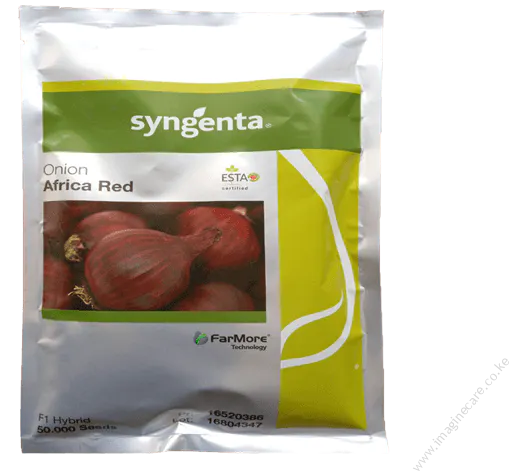
Africa Red F1 onion seeds produce a short-day hybrid red onion developed by Syngenta for open-field production and the fresh market. The variety produces uniform red bulbs with an attractive flat-globe shape, good skin retention and reliable market acceptance.
Africa Red F1 is suitable for commercial onion farmers seeking uniform bulbs, early-to-medium maturity and good storage potential. Under suitable weather, fertile soil, consistent irrigation and effective crop management, the variety has a reported yield potential of up to 25 tonnes per acre.
Africa Red F1 Onion Characteristics
| Characteristic | Details |
|---|---|
| Crop | Bulb onion |
| Variety | Africa Red F1 |
| Breeder | Syngenta |
| Variety code | SG8363 |
| Day-length type | Short-day onion |
| Production system | Open-field production |
| Maturity | Approximately 90 days after transplanting |
| Bulb colour | Uniform deep red |
| Bulb shape | Flat globe or transverse elliptic |
| Bulb size | Approximately 3–6 cm, depending on spacing and crop management |
| Yield potential | Up to 25 tonnes per acre under good agronomic management |
| Market | Fresh-market onions |
| Storage | Good shelf life when bulbs are properly matured, cured, graded and stored |
Why Grow Africa Red F1 Onions?
- Produces uniform red-coloured bulbs.
- Attractive flat-globe bulb shape for fresh-market sales.
- Good skin retention for handling and marketing.
- Relatively thin necks that support proper curing.
- Wide adaptability under suitable short-day production conditions.
- High tolerance to bolting.
- Good shelf-life potential after correct harvesting and curing.
- Potential yield of up to 25 tonnes per acre under good management.
Suitable Growing Conditions
Africa Red F1 performs best in fertile, well-drained soil with consistent moisture and adequate sunlight. A soil pH of approximately 6.0–6.8 is generally suitable for onion production. Avoid saline, heavily compacted or waterlogged fields because restricted root development can reduce bulb size and uniformity.
Use a soil test to determine the required fertiliser and soil-amendment programme. Prepare a fine, firm seedbed and ensure the selected field has not recently carried onions, garlic, leeks or other related crops where soil-borne diseases are a concern.
Nursery Establishment
- Prepare raised nursery beds in a clean, well-drained location.
- Make shallow rows and sow the seeds thinly to avoid overcrowding.
- Cover the seeds lightly with fine soil or a clean nursery medium.
- Water gently and maintain even moisture without flooding the bed.
- Provide light mulch until emergence, then remove it promptly.
- Control weeds early and scout regularly for thrips, damping-off and foliar diseases.
- Harden seedlings gradually before transplanting.
Transplant healthy, uniform seedlings when they have developed sufficient strength to withstand field conditions. Avoid transplanting weak, overgrown or diseased seedlings.
Recommended Field Spacing
Final spacing should reflect the target bulb size, irrigation method and local agronomic advice. A commonly used commercial spacing is approximately 30 cm between rows and 8–10 cm between plants. Closer spacing may produce smaller bulbs, while wider spacing may support larger individual bulbs but reduce the plant population.
Fertiliser and Irrigation Management
Apply fertiliser according to soil-test results and expected yield. Onions require adequate phosphorus for root development and balanced nitrogen and potassium for leaf growth, bulb development, firmness and quality.
Avoid excessive late nitrogen because it can delay maturity, produce thick necks and reduce storage quality. Where top dressing is required, divide applications instead of applying a large amount at once.
Maintain consistent soil moisture, especially during establishment and bulb development. However, avoid prolonged waterlogging. Reduce irrigation as the crop approaches maturity and stop heavy watering before harvesting to encourage proper drying and curing.
Weed, Pest and Disease Management
Keep the crop free from weeds during the early growth stages because onions have shallow roots and compete poorly with aggressive weeds. Use shallow mechanical weeding or a herbicide registered for onions and the identified weed problem.
Scout regularly for:
- Onion thrips
- Onion flies and other root-feeding pests
- Cutworms
- Downy mildew
- Purple blotch
- Botrytis diseases
- Damping-off in the nursery
- Bacterial soft rots
Africa Red F1 should not be described as immune or resistant to these problems unless the current Syngenta technical information specifically states such resistance. Use clean seedlings, crop rotation, good field sanitation, balanced nutrition and registered crop-protection products.
Before applying any pesticide, confirm that it is registered in Kenya for onions and the identified pest or disease. Follow the label rate, wear protective equipment and observe the stated pre-harvest and re-entry intervals.
Harvesting Africa Red F1 Onions
Africa Red F1 reaches maturity approximately 90 days after transplanting, although temperature, altitude, planting season, nutrition and irrigation can affect the actual harvest date.
Harvest when most tops have fallen naturally and the bulbs have developed their expected colour and size. Avoid forcing immature tops down because this can interfere with natural maturity and storage quality.
Curing and Storage
- Harvest during dry weather whenever possible.
- Handle the bulbs carefully to prevent cuts and bruising.
- Cure them in a dry, shaded and well-ventilated area.
- Allow the necks and outer skins to dry properly.
- Remove damaged, diseased or thick-necked bulbs before storage.
- Store only properly cured bulbs in a cool, dry and ventilated facility.
- Inspect stored onions regularly and remove rotting bulbs.
Storage duration depends on bulb maturity, curing quality, temperature, humidity, ventilation and freedom from pests and diseases. Therefore, storage life should not be treated as guaranteed under every farm or store condition.
Expected Yield
Africa Red F1 has a reported yield potential of up to 25 tonnes per acre under good agronomic management. Actual production depends on seed quality, plant population, soil fertility, irrigation, weather, pest and disease management, bulb size requirements and post-harvest handling.
Buy Africa Red F1 Onion Seeds in Kenya
Buy genuine Africa Red F1 onion seeds in Nairobi, Kenya from Dawn Farmers Ltd. Confirm the available pack size, current price and stock before ordering. Delivery arrangements are available to onion-growing areas across Kenya.
- Call or WhatsApp: 0748 949 184
- Location: Mang Building, Haile Selassie Avenue, Nairobi
- Website: https://dawnfarmers.com
- Order online: Africa Red F1 Onion Seeds
Dawn Farmers Ltd — Empowering farmers, feeding the nation.
Frequently Asked Questions
How long does Africa Red F1 take to mature?
Africa Red F1 matures approximately 90 days after transplanting. Weather, altitude and crop management can affect the actual maturity period.
What is the yield potential of Africa Red F1 onions?
The variety has a reported potential of up to 25 tonnes per acre under good agronomic management. Yield is not guaranteed and varies with field conditions and management.
What colour and shape are Africa Red F1 bulbs?
The variety produces uniform red bulbs with an attractive flat-globe or transverse-elliptic shape.
Is Africa Red F1 suitable for storage?
It has good shelf-life potential and skin retention. However, successful storage depends on harvesting mature bulbs, proper curing, careful grading and a cool, dry, ventilated store.
Where can I buy Africa Red F1 onion seeds in Nairobi?
Africa Red F1 onion seeds are available from Dawn Farmers Ltd at Mang Building along Haile Selassie Avenue in Nairobi. Call or WhatsApp 0748 949 184 to confirm stock and delivery arrangements.