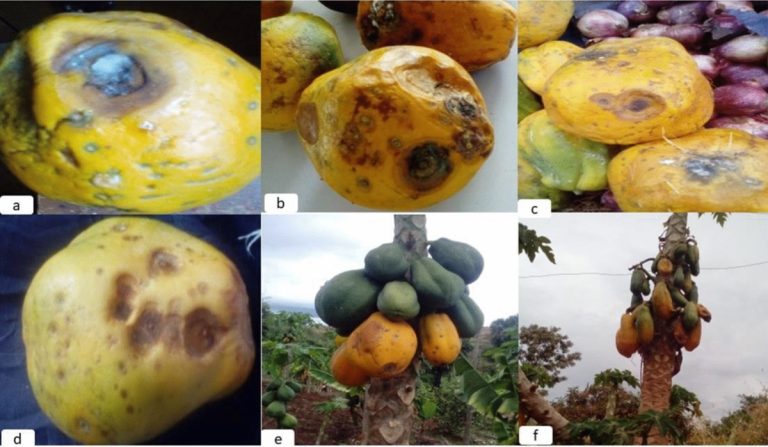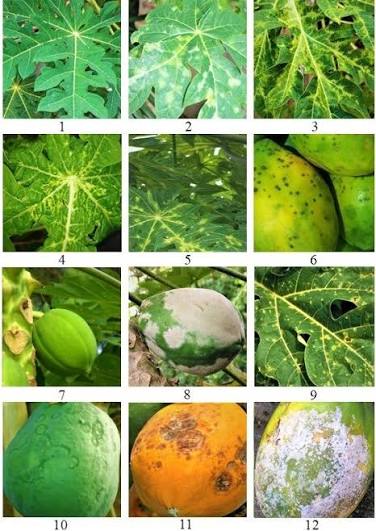
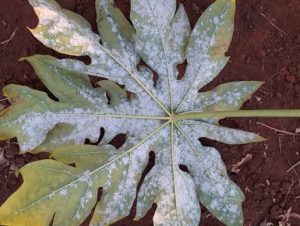
What Causes Pawpaw Powdery Mildew?
Pawpaw powdery mildew is linked to fungi such as Oidium caricae. The fungus mainly attacks leaves. However, it may also affect leaf stalks, seedlings and young fruits.
First, fungal spores land on the plant surface. Afterwards, they grow into a fine white coating. Wind then carries new spores to nearby plants. Therefore, the disease can spread quickly through a crowded pawpaw field.
Unlike anthracnose, powdery mildew does not need heavy rain to infect plants. Instead, it develops well during humid weather when leaves remain mostly dry.
Conditions That Favour Powdery Mildew
Several conditions increase the risk of pawpaw powdery mildew. For example, high humidity combined with poor airflow allows the fungus to spread rapidly.
- Warm days followed by cool nights
- High humidity and heavy morning dew
- Dense or shaded pawpaw fields
- Poor airflow between plants
- Excessive nitrogen fertilizer
- Weak or stressed plants
- Old infected leaves left in the field
- Failure to treat the first signs promptly
Therefore, farmers should inspect the lower surfaces of pawpaw leaves every week. In addition, crop checks should become more frequent when weather conditions favour the disease.
How to Identify Powdery Mildew on Pawpaw
Early signs on pawpaw leaves
- At first, pale yellow or light-green patches appear on the leaves.
- Soon afterwards, fine white or grey powder forms on the lower surface.
- As infection grows, the powder spreads to the upper leaf surface.
- Meanwhile, young leaves may curl or lose their normal shape.
- Eventually, leaf growth slows down.
Signs of severe infection
- Large areas of the leaf become covered with white powder.
- Later, infected sections turn yellow and then brown.
- In severe cases, affected leaves dry and fall early.
- As a result, the plant loses part of its food-making surface.
- Furthermore, fruits become exposed to direct sunlight and may suffer sunburn.
Signs on young pawpaw fruits
- Sometimes, a fine white coating develops on young fruits.
- Afterwards, affected areas may become rough or corky.
- Infection may also slow fruit growth.
- Even after control, old fruit scars may remain visible.
Is It Powdery Mildew or Another Pawpaw Problem?
White material on pawpaw leaves does not always indicate powdery mildew. Therefore, farmers should examine the plants carefully before spraying.
| Signs observed | Likely cause | Main difference |
|---|---|---|
| White or grey powder that continues spreading | Powdery mildew | The powder develops on living leaf tissue and may wipe off temporarily. |
| Black coating with sticky deposits | Sooty mould | Aphids, whiteflies, scales or mealybugs usually produce the sticky material. |
| Fine webbing with many small yellow spots | Spider mites | Mites or eggs may be visible under the leaves. |
| White cotton-like clusters around leaf joints | Mealybugs | Individual insects appear inside the cotton-like wax. |
| White marks that do not spread | Spray or fertilizer residue | The marks remain where the spray droplets dried. |
Can Fungicides Cure Pawpaw Powdery Mildew?
Systemic fungicides can control an early infection and protect new plant growth. Contact fungicides, on the other hand, protect the surfaces they cover.
However, neither type can turn a dead leaf green again. Therefore, remove badly infected old leaves while retaining enough healthy foliage to shade the fruits.
Recommended Fungicide for Pawpaw Powdery Mildew
Absolute Star 400SC
Absolute Star 400SC is a broad-range systemic fungicide containing two active ingredients:
- Azoxystrobin 250 g/L – FRAC Group 11
- Difenoconazole 150 g/L – FRAC Group 3
Azoxystrobin helps prevent spore growth. Meanwhile, difenoconazole moves into the plant and controls early fungal growth. Consequently, the product provides preventive and early curative action.
| Rate per 20 litres | 8–10 ml |
|---|---|
| Spray interval | 7–14 days, according to disease pressure and label instructions |
| Type of action | Systemic, preventive and early curative |
| FRAC groups | 11 + 3 |
| PHI | Follow the pawpaw PHI on the current Kenyan product label |
Use the lower label rate for preventive protection. However, apply the upper label rate when the first white patches appear or disease pressure becomes high.
Thiovit Jet for Powdery Mildew
Thiovit Jet contains sulphur 800 g/kg and belongs to FRAC Group M02. It works mainly as a contact fungicide. In addition, its vapour action helps reach parts of the plant close to the treated surface.
| Published rate per 20 litres | 80 g |
|---|---|
| Type of action | Contact, preventive and suppressive |
| FRAC group | M02 |
| Published PHI | 3 days |
| Pawpaw requirement | Confirm that the current Kenyan label permits use on pawpaw |
Although Syngenta Kenya publishes these general figures, farmers must confirm that pawpaw appears on the current product label. If the crop is absent, seek guidance from the manufacturer or a qualified crop adviser.
Important sulphur precautions
- Avoid spraying sulphur during very hot weather.
- Likewise, do not spray wilted or drought-stressed plants.
- Keep sulphur separate from mineral and horticultural oils.
- Unless the labels state otherwise, leave at least 14 days between oil and sulphur sprays.
- Before full application, test the treatment on a few pawpaw plants.
- During spraying, ensure that leaves receive even coverage.
Young pawpaw growth may suffer spray injury under hot conditions. Therefore, avoid applying Thiovit Jet when temperatures are high.
How and When to Spray Powdery Mildew
Preventive application
Begin preventive action when weather conditions favour powdery mildew. In particular, monitor closely during warm days, cool nights and periods of heavy dew.
Where the label permits, apply a preventive product before white growth covers large areas of the leaves. Early treatment is both cheaper and more effective.
Spraying after symptoms appear
- First, inspect both sides of the pawpaw leaves.
- Next, remove badly infected old leaves.
- Keep enough healthy foliage to protect fruits from sunburn.
- Afterwards, prepare the selected fungicide at its label rate.
- Direct the spray towards both leaf surfaces.
- Also, cover young leaves, leaf stalks and developing fruits lightly.
- Check the crop again after five to seven days.
- Finally, repeat treatment according to the label and disease pressure.
During fast disease spread, use the shortest label-approved interval. Conversely, a longer interval may be suitable when disease pressure is low.
Best Time to Spray Pawpaw
- Ideally, spray after the morning dew has dried.
- Alternatively, apply treatment in the late afternoon.
- During application, avoid strong wind.
- Likewise, avoid extreme heat.
- If rain is expected immediately, postpone spraying.
- After treatment, allow the leaves enough time to dry.
Good timing reduces product loss. Moreover, it gives the fungicide enough time to settle on or enter the leaves.
How to Mix a 20-Litre Spray
- Before mixing, wear gloves, boots, protective clothing and eye protection.
- First, half-fill a clean knapsack with water.
- Meanwhile, shake liquid fungicide containers thoroughly.
- Next, measure the correct quantity of fungicide.
- Add the product while gently stirring the water.
- Where necessary, add only compatible and label-approved products.
- Afterwards, top up the knapsack to 20 litres.
- Mix the solution again.
- Finally, spray the mixture on the same day.
Do not keep mixed spray overnight. Instead, prepare only the amount required for immediate use.
Using Integra Spray Adjuvant
Where the product labels permit, add Integra at 3 ml per 20 litres to an Absolute Star spray. The adjuvant helps the fungicide spread over the leaf surface.
However, powdery mildew can make leaves delicate. Therefore, avoid excessive wetter and test the mixture on a few plants first.
Do not automatically add Integra to Thiovit Jet. Instead, check both labels because sulphur products may require their own mixing instructions.
Fungicide Compatibility
Absolute Star compatibility
- First, read all product labels before tank mixing.
- Afterwards, conduct a jar test using the intended spray water.
- Strongly alkaline products should be avoided.
- Unless both labels permit it, keep copper and sulphur products separate.
- Also, take care with concentrated foliar feeds.
- If compatibility remains uncertain, apply each product separately.
Thiovit Jet compatibility
- Never combine sulphur with mineral or horticultural oils unless the labels allow it.
- During hot weather, avoid mixtures that may increase leaf burn.
- Similarly, avoid untested combinations with emulsifiable concentrates.
- Before mixing with another pesticide, conduct a jar test.
- Finally, carry out a small crop-safety test.
A jar test only confirms that products can mix physically. It does not confirm crop safety, field performance or legal approval.
Pre-Harvest Interval
The PHI is the minimum period between the final spray and harvesting. Therefore, every farmer must record both spray dates and planned harvest dates.
| Product | Published PHI | Action required |
|---|---|---|
| Absolute Star 400SC | No clear pawpaw-specific PHI published online | Follow the current Kenyan pawpaw label |
| Thiovit Jet | 3 days on Syngenta Kenya’s product page | Confirm that the label includes pawpaw |
Never transfer a PHI from tomato, mango, onion or another crop to pawpaw. If the crop does not appear on the product label, consult the manufacturer before spraying marketable fruits.
How to Prevent Fungicide Resistance
Powdery mildew can develop resistance when farmers repeat the same fungicide groups. Therefore, a good programme should rotate approved modes of action.
- Avoid repeated back-to-back applications of Absolute Star.
- Instead, rotate with a pawpaw-approved fungicide from a different FRAC group.
- Nativo is not a suitable rotation partner because it also contains Groups 11 and 3.
- Where its pawpaw label permits, sulphur provides a different multi-site mode of action.
- Always use the complete label rate.
- In addition, combine spraying with good canopy care.
- Finally, record every product, FRAC group and application date.
Agronomic Control of Pawpaw Powdery Mildew
Improve airflow
- Maintain the recommended plant spacing.
- Where necessary, remove old leaves carefully.
- Regularly control weeds within the orchard.
- For better airflow, avoid dense intercrops.
As a result, humidity falls and leaves remain less favourable for fungal growth.
Manage plant nutrition
- Base fertilizer use on soil and leaf-test results.
- Avoid excessive nitrogen application.
- Instead, maintain balanced potassium, calcium and micronutrient supply.
- During dry periods, irrigate consistently to reduce plant stress.
Excess nitrogen produces soft and crowded leaf growth. Consequently, the crop may become more prone to powdery mildew.
Remove sources of infection
- During field checks, remove badly infected old leaves.
- After pruning, collect the removed material.
- Clean pruning tools before moving to healthy plants.
- Finally, keep the production area free from weeds and crop waste.
Simple Powdery Mildew Spray Guide
| Crop condition | Recommended action |
|---|---|
| No symptoms | Inspect both sides of the leaves every week. |
| Weather favours infection | Improve airflow and apply a label-approved preventive fungicide. |
| First white patches appear | Remove badly affected leaves and apply Absolute Star at 8–10 ml per 20 litres. |
| Rapid disease spread | Use the shortest label-approved interval and improve coverage. |
| Repeated Group 11 and 3 use | Rotate to a pawpaw-approved product from a different FRAC group. |
| Close to harvest | Confirm the crop-specific PHI before spraying or picking fruits. |
Frequently Asked Questions
What causes white powder on pawpaw leaves?
A spreading white or grey coating may indicate powdery mildew. However, farmers should also check for mealybugs, mites and dried spray deposits.
What is the Absolute Star rate per 20 litres?
The published rate is 8–10 ml per 20 litres. Nevertheless, farmers must follow the current Kenyan label.
What is the Thiovit Jet rate per 20 litres?
Syngenta Kenya publishes a rate of 80 g per 20 litres. However, the current label must permit its use on pawpaw.
Can sulphur burn pawpaw leaves?
Yes. Sulphur can damage tender or stressed leaves during hot weather. Therefore, spray during cooler conditions and test a few plants first.
Can Absolute Star and Nativo be used in rotation?
No. Both products contain FRAC Groups 11 and 3. Consequently, switching between them does not provide an effective resistance rotation.
Where can farmers buy pawpaw fungicides in Nairobi?
Farmers can obtain genuine fungicides, adjuvants, seeds and sprayers from Dawn Farmers Ltd at Mang Building along Haile Selassie Avenue, Nairobi. Call 0713 064 228 for availability and agronomic guidance.
Get Pawpaw Disease-Control Advice in Nairobi
Early diagnosis helps farmers avoid crop losses and unnecessary spray costs. Therefore, bring clear photographs or affected leaf and fruit samples to Dawn Farmers Ltd for assessment.
Visit Dawn Farmers Ltd at Mang Building along Haile Selassie Avenue, Nairobi. Alternatively, call 0713 064 228 or shop online through Dawn Farmers Ltd.
Dawn Farmers Ltd – Empowering farmers, feeding the nation.
Related Pawpaw Products from Dawn Farmers Ltd
Effective powdery mildew control requires the correct fungicide, good spray coverage and healthy planting material. Therefore, consider the following related products:
Absolute Star 400SC Fungicide
– provides preventive and early curative fungal control.
Thiovit Jet Fungicide
– a sulphur-based contact product for powdery mildew where the label permits pawpaw use.
Integra Spray Adjuvant
– improves spray coverage where the relevant labels allow mixing.
Jacto XP Knapsack Sprayer
– supports accurate spraying and even leaf coverage.
Vega F1 Hybrid Pawpaw Seeds
– suitable for early commercial pawpaw production.
Malkia F1 Papaya Seeds
– quality hybrid seed for commercial papaya farming.